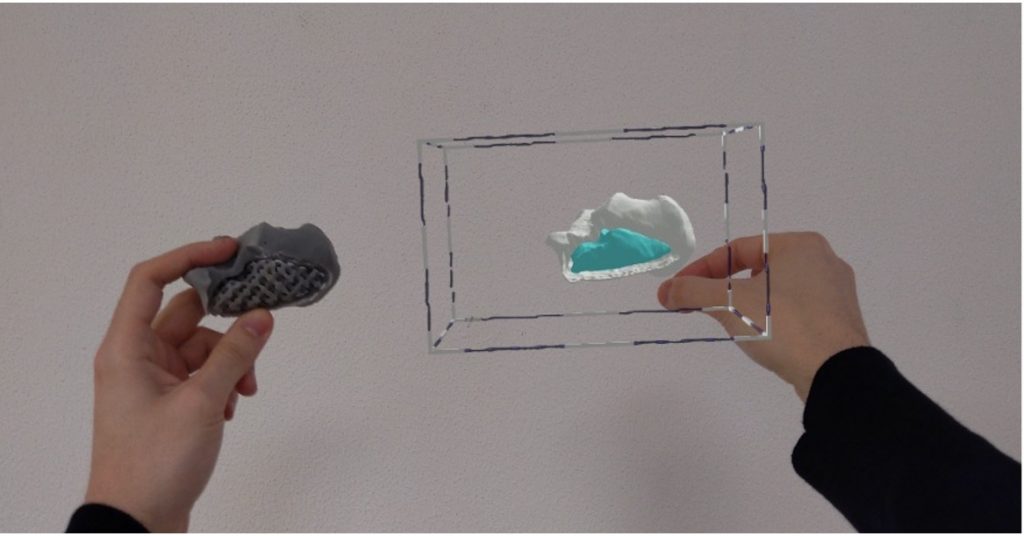
Hi, I’m Gianni, a 28-year-old PhD student from Italy, but currently living in Krakow, Poland, trying to understand the difference between ravioli and pierogi. No, really. Why Krakow? I love travelling, and I love science, so when they offered me a PhD abroad in mixed reality for healthcare, I simply couldn’t say no. My PhD project is to create preprocedural planning for bone implant fitting by using mixed reality. I know I’ve already lost you. What are bone implants? Where do we want to fit them? And why the PhD? Unfortunately, I have no answer to the last question.
Bone tissue is really fascinating because it has self-healing mechanisms that allow it to regenerate, but in some cases, such as tumours or fractures, this is not possible anymore, or at least not entirely. In the ReBone Doctoral Network, we work with exactly these cases. When a bone defect exceeds 2-3 cm, we have a critical-size defect. This means bone regeneration cannot be completed on its own, and we need different strategies to support it. Bone implants or scaffolds are one of these. Bone scaffolds are inserted into the defect to fill it, and they are designed with a porous structure to allow bone cells to grow and stimulate regeneration.
My job is to find the right trajectory to insert these implants without touching one of the many dangerous structures in our body, such as vessels, nerves, and other bones. As part of the ReBone project, I’m collaborating with 9 other young researchers with expertise ranging from 3D printing to cell culture, because before implanting these implants, we first need to design them, then print them, and finally find the safest route through our body.
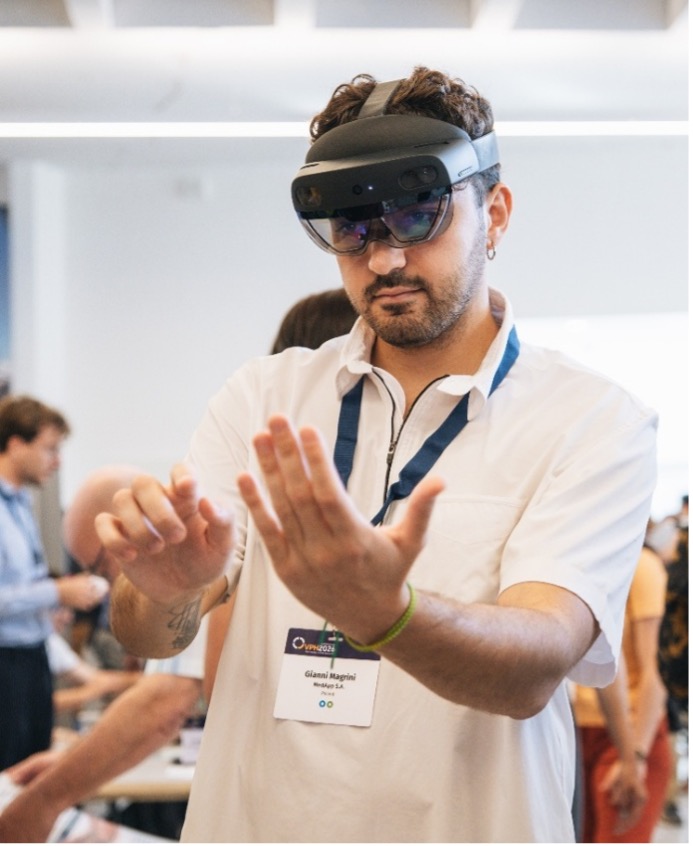
But let’s come back to the main question, and everything will be clearer: why those weird “glasses”? What is their magical power? Here are the answers…
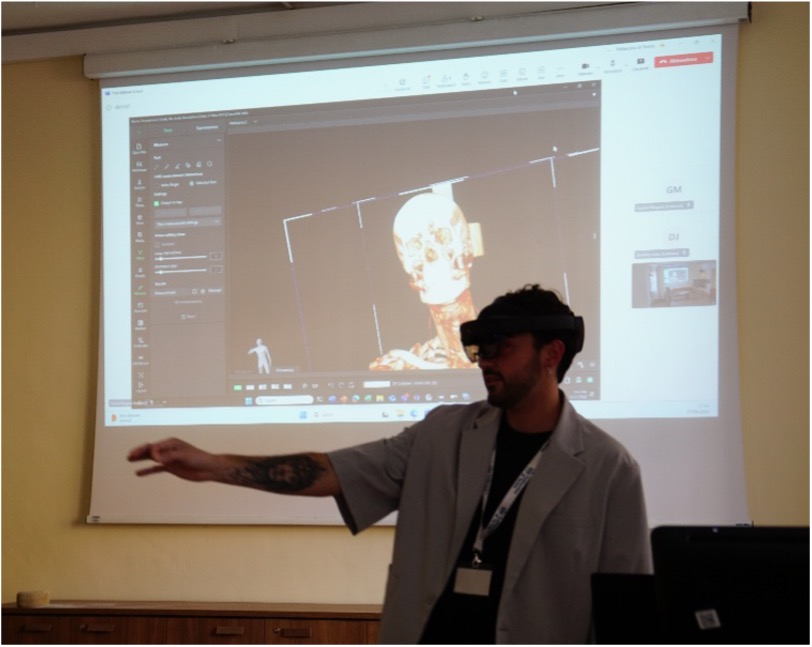
Basically, I use software called CarnaLife Holo (by MedApp S.A.) that lets you visualise the patient’s hologram alongside the patient. Sounds amazing, right?! The hologram comes from the clinical images that you and/or one of your relatives have had at least once in your life, such as a CT scan or an MRI. Then the software can create a 3D reconstruction of these images and show it in our world, but we still need something. THE GLASSES!
These “glasses”, or more correctly, the headset, are what make it possible. The headset allows the user to visualise the hologram, a virtual element, together with our reality (our house, our office, and guess what? The surgical room!). You may have heard of virtual reality; if not, it’s a similar technology, but it lets you visualise only virtual elements in a virtual space. Medical students can use virtual reality to better understand anatomy, but it can also be used for video games (usually to escape ghosts or kill zombies).
Instead, mixed reality, as the word suggests, allows interaction between virtual and physical elements (the surgeon’s hands, the surgical desk, and the patient). This is the main advantage, because the surgeon can use it to study a special case and also use it directly in the operating room as an additional tool for complex procedures.
If you want to follow my journey, you can see more details in my LinkedIn profile. It’s easy to find me; follow the weird glasses!
Hi, I’m Gianni Magrini, an Italian bioengineer with a passion for photography and travelling. I go everywhere with my heavy camera, trying to capture cute animals, brutalist architecture, or interesting people on the streets. I was born in Milan, but I currently live in Krakow for my PhD and to catch all the little dragons hidden in the city.